
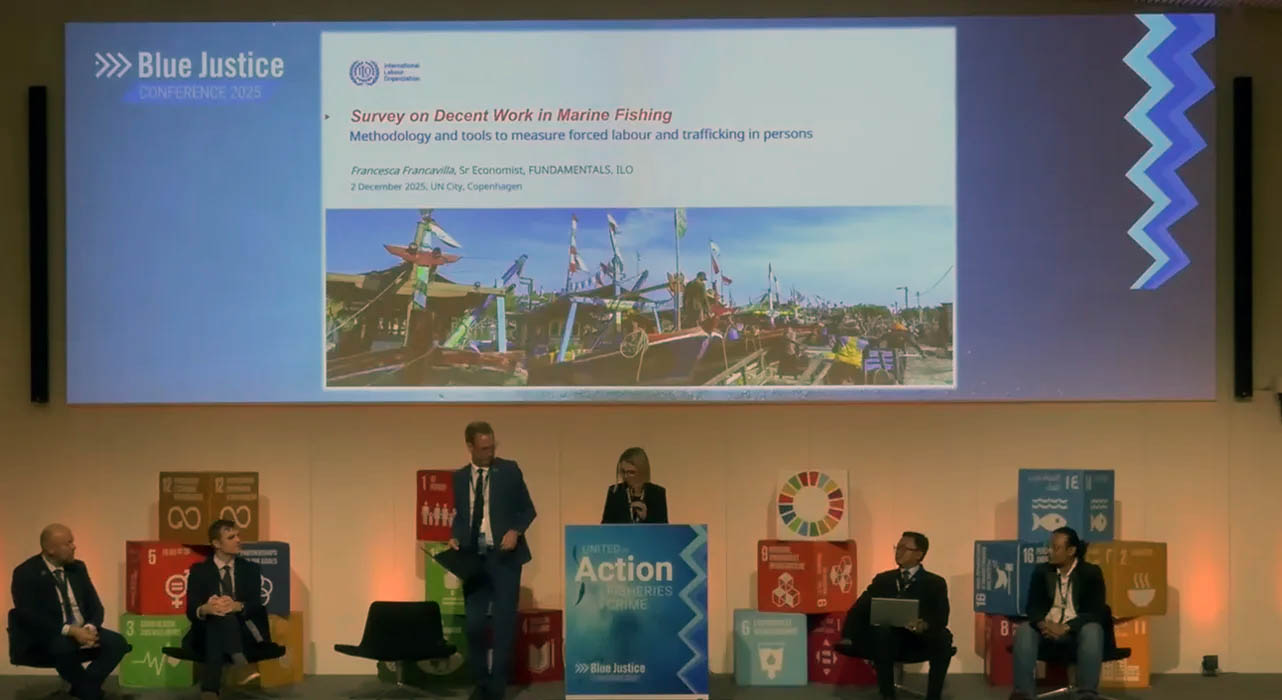
An innovative methodology developed by the International Labour Organization is providing countries with the first statistically robust data on forced labour and human trafficking in marine fishing.
For decades, anecdotal cases and isolated reports have hinted at the reality of forced labour and human trafficking in the global fishing industry. But without reliable, comparable data, governments have struggled to grasp the true scale of the problem – or to design effective responses. A groundbreaking survey methodology developed by the ILO now provides a tool to change that.
The tool was presented to the Blue Justice family in Copenhagen in December 2025. The Copenhagen Declaration on transnational organized crime in the global fishing industry contains an explicit reference to human trafficking as part of transnational organized crime in the fishing industry. The Declaration also recognizes the need for interagency and cross-border action to fight forced labour and trafficking for forced labour.‑
“It is against this backdrop that the Blue Justice initiative collaborates with the ILO to create methods and tools to measure trafficking in the fishing sector,” says Francesca Francavilla, Senior Economist at the ILO. In particular, the ILO has collaborated with UNODC and the IOM in a UN inter‑agency project to develop a common methodology to measure trafficking in fishing.
Translating Standards to Indicators
The toolkit translates international standards – including the Work in Fishing Convention, 2007 (No. 188), the Forced Labour Convention, 1930 (No. 29) and the Palermo Protocol – into concrete indicators for the purpose of measurement. In practice, this means asking fishers whether they were deceived about working at sea, about pay, time at sea or living conditions, and whether they would have accepted the job if they had known the truth. It means asking whether they face threats of violence, loss of pay, physical abuse, denial of food, water or breaks if they complain; whether their documents are withheld and access to them is denied; whether they are kept in debt bondage or threatened with being reported to the authorities if they try to leave. It also means documenting working and living conditions: hours of rest, access to contracts, methods of payment, access to food and clean water, safety hazards, and coverage by social security.
“This partnership is also an opportunity to make these tools available for the Blue Justice community and to create synergy with other development cooperation projects,” says Francesca. The methodology produces data that are statistically representative, comparable over time to measure progress, and standardized so results can be compared across countries.
Creating the Right Incentives
Encouraging more countries to adopt the survey requires creating positive incentives for transparency. As Francavilla observes, increased openness can lead to greater scrutiny, highlighting the need for adequate support and capacity-building.
But she argues that the tide is turning. International markets increasingly demand transparency about forced labour in supply chains. “We are clearly moving in a direction where there is an increasing need to understand whether what we consume is produced with forced labour or with respect for human rights,” Francavilla says.
A Tool for All Stakeholders
The survey methodology is explicitly tripartite – involving government, employers and workers’ representatives at every stage. This ensures that the results address the needs of all parties and creates space for dialogue around often contentious issues.
The Indonesia report, for example, includes ten recommendations for governments, workers’ representatives and employers based on the evidence collected.
“The survey is not intended to identify specific vessel owners or companies that violate labour standards, as enforcement is the responsibly of the competent authorities,” Francavilla stresses. “Rather, it aims to provide countries with the evidence they need to inform and advance reforms.”
The ideal next step, after implementing reforms, is to repeat the survey five years later. “You examine the reforms put in place, and see whether the numbers have improved. That is the idea.”
Indonesia: first national picture at scale
The methodology has already been field-tested in Ghana, South Africa and Indonesia – with Indonesia completing the largest-ever national survey of its kind, interviewing 3,400 fishers across the archipelago. When Indonesian researchers sat down with fishers in ports and coastal communities, clear patterns emerged. The survey reached both fishers who go home after day trips and those who spend long periods at sea, and included crews on Indonesian-flagged as well as foreign-flagged vessels docking in Indonesian ports.
The findings confirmed what many suspected but could not previously quantify. A significant share of fishers reported deceptive recruitment, including not being told they would work on a fishing vessel, or discovering only later that wages, time at sea or rest hours were much worse than promised. Others reported that they would not have accepted the job if they had known about the level of danger, the length of working hours, or the poor quality of food and drinking water on board. A non‑negligible proportion reported that they could not leave their job because they owed debts to vessel owners, captains or recruiters, feared being reported to authorities, or risked not being paid for work already completed. Some experienced explicit threats, physical violence, or witnessed violence against co‑workers when they raised concerns.
Combined according to the international definitions, these patterns translate into national estimates of how many fishers are in forced labour, and how many of those cases also meet the definition of trafficking in persons for forced labour. Indonesia now has a baseline that can be repeated in five years to assess whether reforms are reducing these numbers.
Indonesian leadership
“What can be observed and measured can be addressed with concrete reforms and policy interventions, while what cannot be measured remains unknown,” says Francesca Francavilla. “The survey is designed to make the invisible visible – in a way that can inform action and that is comparable across countries and over time.”
Indonesia’s decision to conduct this survey required courage. In a global context where many countries fear the reputational damage of transparency, Indonesia chose a different path.
“If the survey reveals cases, that does not mean there are no cases in other countries; it means Indonesia has decided to be transparent, to tackle the issue, and to monitor progress,” says Francavilla. “The survey is a baseline from which you start observing and commit to improving.”
Development cooperation, she suggests, should reward transparency rather than punish it. Countries conducting these surveys should receive greater support in terms of guidance and funding for reforms, is Francavilla’s message.
The toolkit is available here: https://www.ilo.org/resource/training-material/toolkit-surveys-decent-work-marine-fishing