
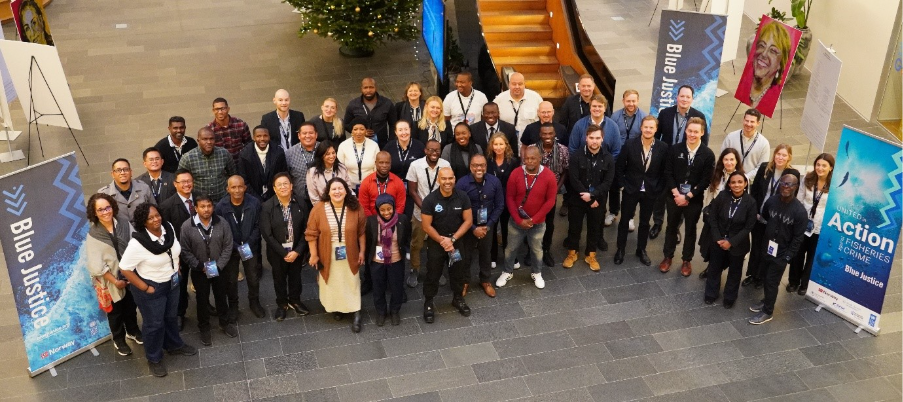
This November, UNDP and Blue Justice will co-host the third Blue Justice Community User Gathering. The three-day technical event will bring together practitioners from around the world and marks an important milestone for the Blue Justice Community. In 2026, more than 600 government representatives from 40 countries are actively engaging on the platform in their operational work, representing 65% of the supporting countries of the Copenhagen Declaration, compared to an initial 41 users from 11 countries when the Community began in 2021.
The theme of this year’s Gathering, Protecting the Aquatic Food System: Cooperative Action Using Digital Tools Against Crimes in the Fisheries Value Chain, reflects how the Community has evolved over the past five years. What began primarily as a space for fisheries agencies has expanded to include customs, coast guard, maritime authorities, police, prosecutors, courts and justice agencies, tax and financial intelligence officials, labour and immigration authorities and others. Today, the Community brings together the full range of agencies that play a role in preventing, identifying, investigating and addressing crime across the fisheries value chain, supporting cooperation to protect the aquatic food system, strengthen human security and promote a fair and sustainable blue economy.
The Community was established as a secure government-to-government practitioner-led forum. Over the years it has developed through multiple iterations in response to the needs of its users, combining vessel tracking and analytical tools with a secure space to exchange experience, knowledge and lessons learned. Community members use the platform in different ways, whether through requests for analytical support, regional engagement, training activities or discussions on the platform itself. What connects these activities is the exchange of practical knowledge between users drawn from real cases and operational experience.
UNDP, through the Blue Resilience project, administers and coordinates the Community and works to ensure that users’ needs continue to inform the platform’s development. In partnership with the Blue Justice International Tracking Centre, UNDP facilitates training on the platform’s digital tools. Already eleven digital training sessions have been delivered in 2026 in response to country requests. These have included agency-specific training for prosecutors, fisheries officials and coast guard officers, country focused training, and more advanced thematic work on track analysis, identification of suspicious vessel behaviour and case development. The sessions are interactive exchanges where users draw on examples from their operational work, discuss current vessels of interest, compare approaches and share lessons learned. The upcoming User Gathering will also include an international scenario-based table-top training exercise developed by the Caribbean Community Implementation Agency for Crime and Security (CARICOM IMPACS), under the Blue Justice Caribbean Hub, together with UNDP and an organising committee comprising a cross-section of Blue Justice Community users from varying agencies across the globe.
At its core, the Blue Justice Community remains practitioner led. The tools, training and analytical support are important, but the Community’s greatest strength continues to be the platform users themselves and their willingness to share knowledge and experience. The User Gathering is an opportunity to bring those operational experts together to reflect on how far the Community has come since 2021 from a fisheries-focused group of users into a practitioner-led platform bringing together the full suite of agencies needed to address crime across the fisheries value chain. This 2026 Blue Justice User Gathering provides the opportunity to take stock and to jointly identify how to continue shaping the Community’s future development.